
Discover what Growth Marketing is, how it works, the main strategies, and why it's the approach that growing companies are using.

O Growth Marketing It is the approach that separates companies that grow consistently from those that rely on luck and intuition.
In this guide, we explain what it is, how it works, and why, without Growth, your marketing is probably wasting budget.
For decades, marketing basically meant one thing: creating campaigns, promoting the brand, and waiting for potential customers to show up. This logic worked in a context where consumers had less access to information, competition was more limited and distribution channels were predictable. But the market changed, and so did the way to grow with it.
If you're managing or growing a company today, you've probably already felt that traditional strategies are no longer sufficient, and that's precisely where Growth Marketing comes on the scene. In our Complete guide to paid traffic, we have already discussed how digital advertisements can be one of the most powerful growth levers when well executed - and Growth Marketing is exactly the philosophy that gives context and coherence to this type of decision.
O Growth Marketing, or growth marketing, is a methodology that places data, testing, and continuous experimentation at the center of all marketing decisions. Unlike the conventional marketing, which tends to focus on visibility metrics such as reach, impressions, or number of followers, Growth Marketing is concerned with concrete and measurable results throughout the customer journey: from the moment someone discovers the brand to the point where they become a loyal customer who actively recommends it to others.
What makes this approach different is not only the focus on results, but the systematic way in which they are pursued. Growth Marketing is based on short cycles of hypothesis, testing, and learning, which allows companies to adapt quickly, eliminate waste, and scale only what has been proven to work.
In this article, we will explain in detail what Growth Marketing is, how it differs from traditional marketing, what are its fundamental pillars and how you can start applying it, regardless of the size of your company.

Growth Marketing can be defined as a strategic approach to marketing focused on the continuous, sustainable, and scalable growth of a company.
This definition, popularized by authors such as Jim Huffman in the book “The Growth Marketer's Playbook”, differs from the more classic view of marketing in that it rejects the idea that growing is just a matter of investing more in advertising or releasing more content. Instead, Growth Marketing proposes that growth is a scientific process: it begins with a deep understanding of the customer, involves identifying the levers that most impact the business, and evolves through constant experimentation to find the mechanisms that work in a repeatable and predictable way.
The concept became widely known through the practices of fast-growing technological startups, such as Dropbox, which managed to multiply its user base exponentially through a simple referral program: for each invited friend who activated an account, both the inviting user and the new user received additional storage space free of charge.
This apparently simple mechanic has been tested, fine-tuned and scaled up based on data and is a clear example of Growth Marketing in action. The idea was not to spend more on advertising, it was to find the right mechanism that would turn the product itself into a vehicle for growth.
[IMAGE: Simplified diagram of the AARRR funnel with the five steps: Acquisition, Activation, Retention, Revenue, and Recommendation]
It is important to clarify right away that Growth Marketing is not synonymous with Growth Hacking, a term that sometimes causes confusion. Growth hacking refers to short-term tactics aimed at quick results, often associated with shortcuts or “loopholes” in the system. Growth Marketing, in turn, has a longer time horizon and a more holistic view: it is concerned not only with the acquisition of new customers, but with the quality of their experience, their retention over time, and their potential to become organic brand promoters. In short, growth hacking can be a tool within Growth Marketing, but the two concepts are not interchangeable.
To understand the real value of Growth Marketing, it is useful to compare it with more conventional marketing, not to say that one is better or worse in absolute terms, but to understand in what contexts each approach makes sense and where the main limitations of the traditional model lie.
Traditional marketing tends to focus your efforts at the top of the funnel: creating brand awareness, attracting attention, and generating leads. The most valued metrics are usually reach, frequency, number of clicks, or cost per lead, and decisions are often made based on intuition, creativity, or industry benchmarks.
This model works reasonably well when the objective is to build visibility at an early stage or to communicate to a very wide audience, which is why major consumer brands continue to invest in television and outdoor advertising, for example.
The problem is that this model doesn't answer a fundamental question well: what happens next? Why did a user who clicked on an ad arrive at the site but didn't convert?
A customer who bought once and never returned, what made them leave? A lead that entered the funnel but was never qualified, where did the process fail?
Traditional marketing rarely has answers to these questions because it rarely addresses them in a systematic way. Growth Marketing, on the contrary, treats each of these questions as data to analyze and an opportunity for optimization.
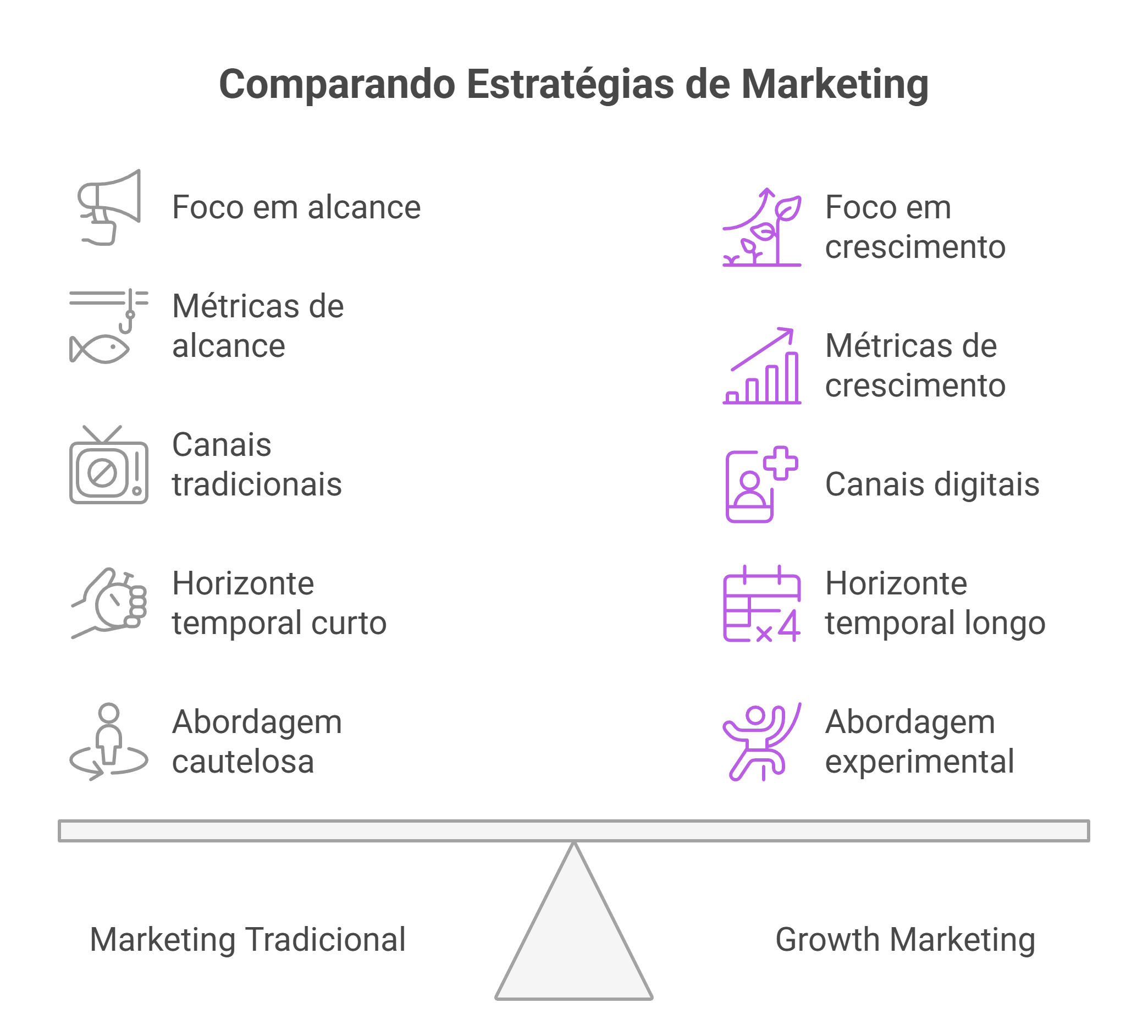
Another fundamental difference lies in the relationship between risk and error. In conventional marketing, a campaign that didn't work is often seen as a failure to avoid. In Growth Marketing, a test that did not generate the expected result is simply a given: it confirms that that hypothesis does not work, which saves time and resources in future decisions. This “fail fast, learn fast” mentality is one of the cultural pillars of Growth Marketing and is closely linked to its efficiency, because a company that tests continuously and learns continuously gets progressively better at predicting what works and avoiding what doesn't.
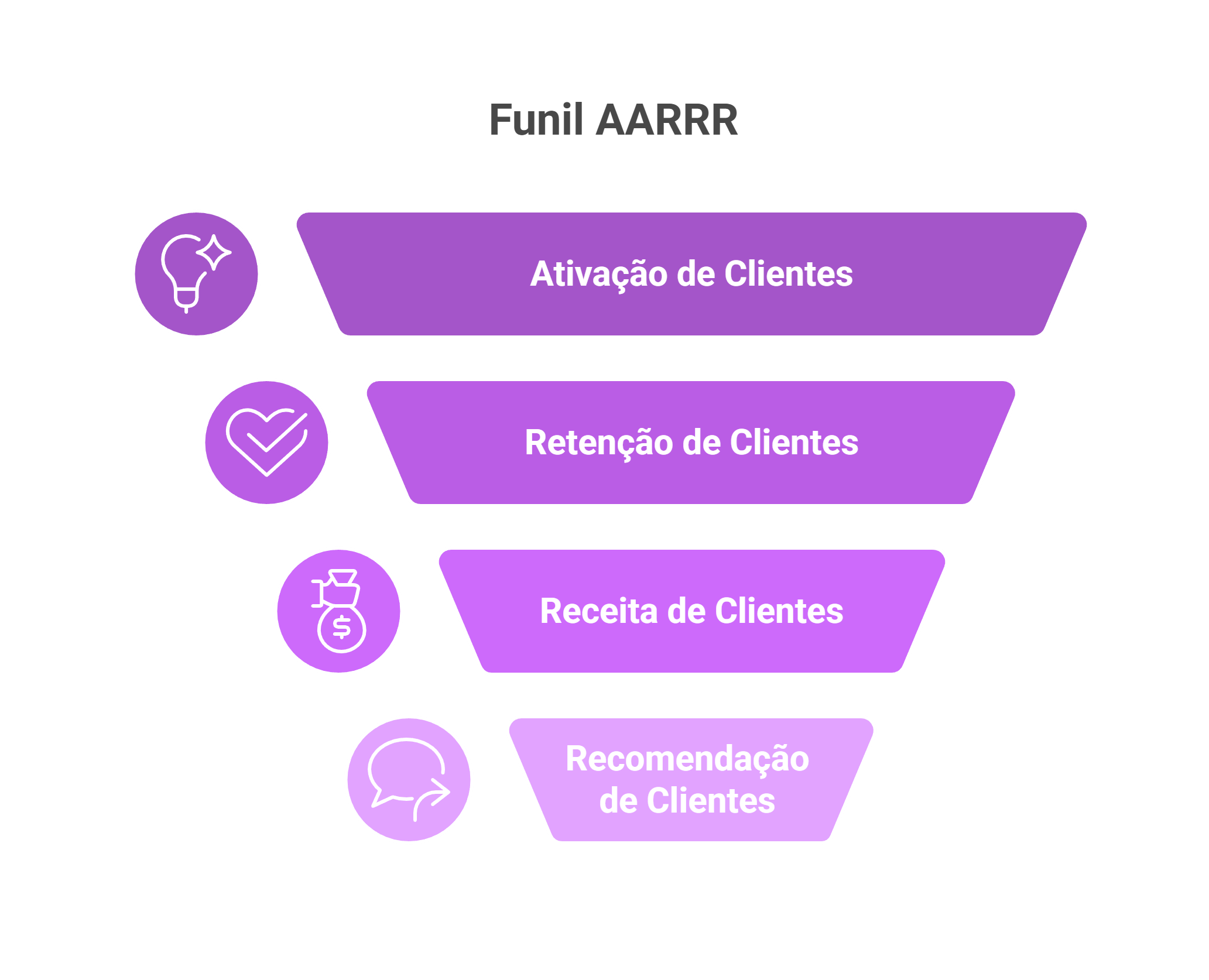
One of the most used frameworks in Growth Marketing is the model AARRR, also known as “pirate funnel”, comes from the acronym that sounds like the classic pirate “aarrr” in English. It was developed by Dave McClure, a renowned American startup investor, and organizes the customer journey in five distinct stages: Acquisition (Acquisition), Activation (Activation), Retention (Retention), Revenue (Recipe) and Referral (Recommendation). The great utility of this model lies in the fact that it forces marketing teams to think of growth as a continuous process and not as a sequence of isolated campaigns.
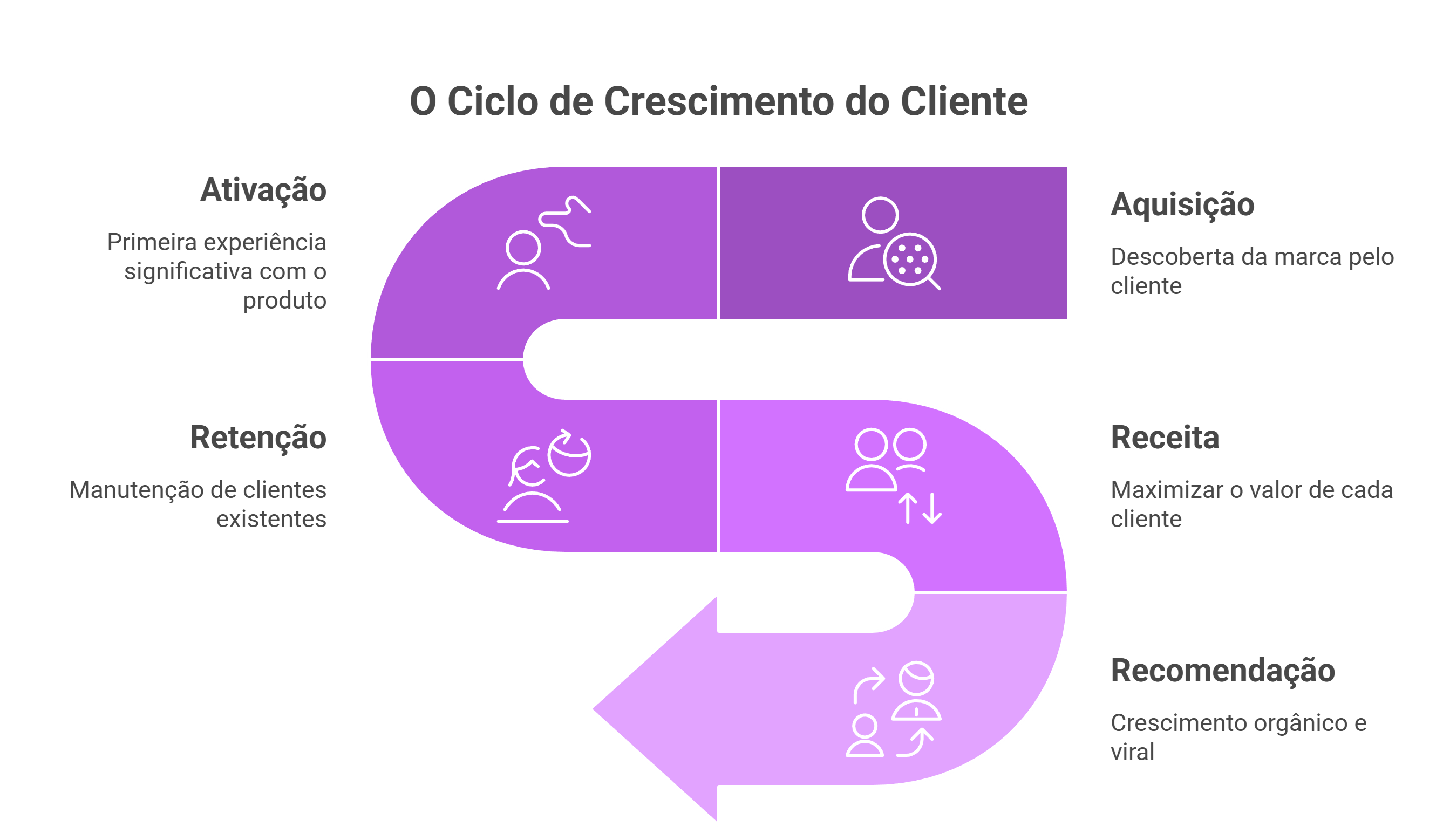
The Acquisition It is the first contact: it is the moment when a potential customer discovers the brand, whether through organic search, paid advertisements, sharing on social networks or through a recommendation. At this stage, the fundamental questions are: where is our audience? What channels are the most efficient to reach him? What is the acquisition cost per channel and how does it compare to the value that this customer will generate in the long term? For Portuguese SMEs, advertising on Google Ads And no Meta Ads they are often the most direct and measurable acquisition channels.
The Activation It is the moment when the user has their first significant experience with the product or service - and it is one of the most undervalued phases in conventional marketing. A company can spend fortunes bringing traffic to their website and lose most of those visitors in the first few seconds because the page doesn't load fast, because the form is too complex, or because the value proposition isn't clear. Growth Marketing treats activation as a priority: if the first impression doesn't convince, all investment in acquisition was in vain.
The Retention it is probably the most critical stage for business profitability. Retaining an existing customer is, on average, five to seven times cheaper than acquiring a new one, and customers who stay longer tend to spend more, be less price sensitive, and refer more people. Growth Marketing looks at retention metrics such as the rate of Churn (customer outflow), the Lifetime Value (value generated by the customer over time) and the purchase frequency, and develops specific strategies to improve each of them: personalized email sequences, loyalty programs, post-sales communication, re-engagement notifications, and others.
The Recipe it's not just about generating sales, but about maximizing the value of each existing customer. At this stage, strategies such as upselling (offer a higher-value product or service), cross-selling (suggest complementary products) or the optimization of the checkout process to reduce cart abandonment. In many companies, there is an enormous opportunity for growth here without increasing a cent of acquisition investment — simply by making the process of generating revenue from the existing customer base more efficient.
The Recommendation it is the phase where growth begins to have an organic and viral component. A satisfied customer who recommends the brand to a friend not only brings a new customer at zero cost, but also increases the company's credibility in a way that no advertisement can replicate. Growth Marketing actively encourages this behavior through referral programs, requests for evaluation at strategic moments in the customer journey, and by ensuring that the experience is good enough to generate spontaneous recommendations.
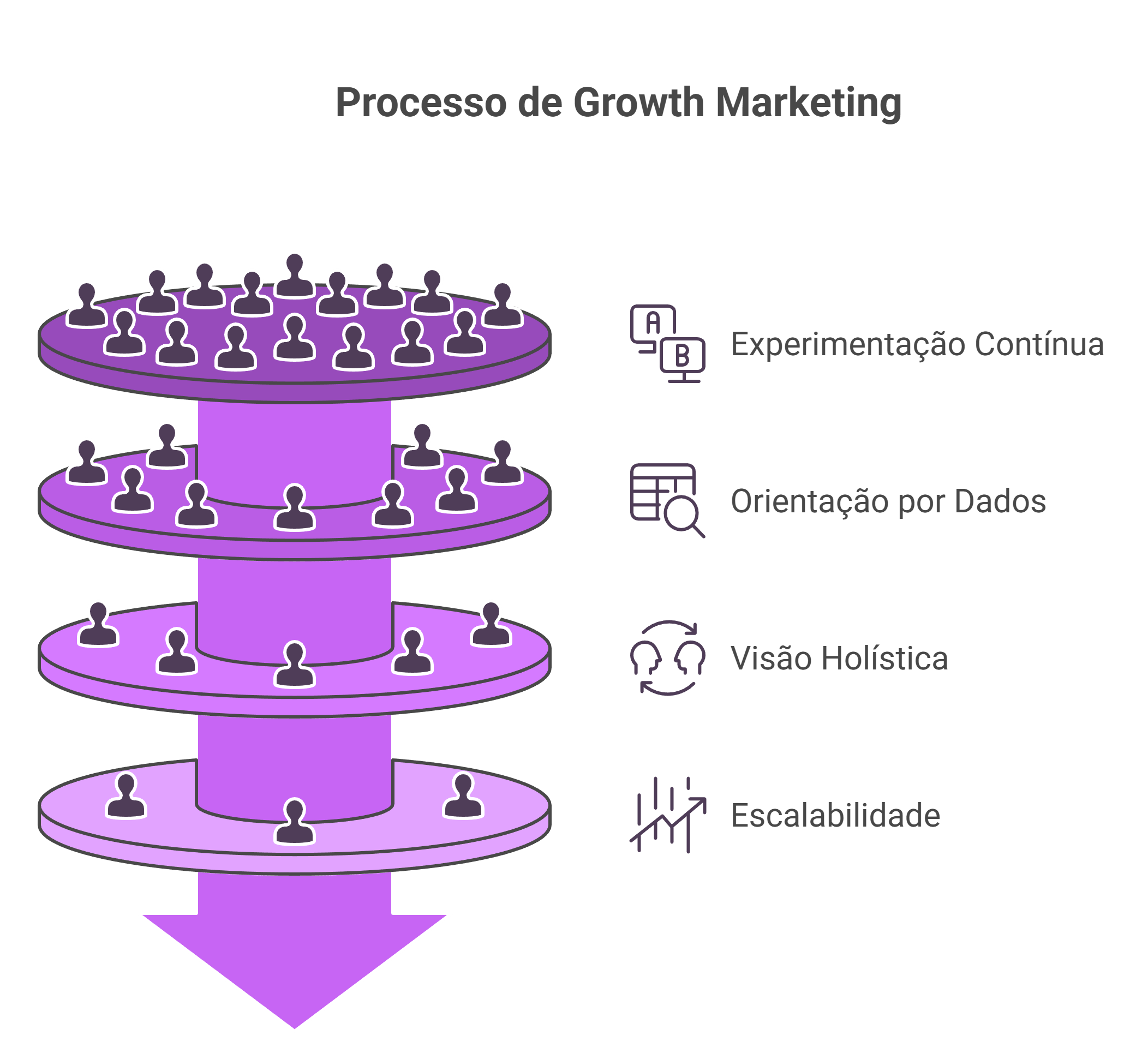
In addition to the AARRR funnel, Growth Marketing is based on methodological pillars that define the way in which teams work and make decisions.
Growth Marketing is based on a logic of continuous testing: A/B tests, tests of Copy, variations of landing pages and new channels, with the sole purpose of discovering what works through concrete evidence. This implies accepting that most tests will fail, but each failure generates learning, and each learning reduces future waste, making the strategy progressively more efficient and predictable. A company that tests a copy variation in an email campaign and discovers that a specific approach generates 30% more clicks isn't just improving that campaign: it's learning something about its audience that it can apply to all subsequent communication points.
No decision in Growth Marketing should be made based on intuition or on “what seems good to me”. All hypotheses need to be formulated with a clear success metric before being tested—and the results need to be rigorously analyzed to draw valid conclusions. This requires a culture of familiarity with data analysis tools such as Google Analytics 4, CRM platforms and campaign monitoring panels, as well as the ability to distinguish correlations from causality. For many SMEs, this is the biggest challenge: there is no lack of desire to grow, there is a lack of the measurement system that allows us to know exactly what is working and what is not.
[IMAGE: Growth metrics dashboard with KPIs such as CAC, LTV, retention rate, and ROAS, in a modern analytics interface]
Unlike traditional marketing, which tends to exist in a “silo” - separated from sales, product, and customer service -, Growth Marketing considers the company as a whole and seeks growth levers in all departments. The feedback that the sales team obtains from customers can inform a new approach to copywriting. A flaw in the onboarding process identified by the customer support service can be corrected with a sequence of automated emails. A product feature that users love the most can be highlighted in ads to increase the conversion rate. This cross-sectional view is one of the greatest sources of value in Growth Marketing and is also one of the reasons why, when well implemented, it generates results that no single campaign can achieve.
One of the central objectives of Growth Marketing is to discover what works and then create the conditions for it to work on a larger scale. This is very different from volume marketing: it's not about launching more campaigns, but about optimizing those that have already demonstrated results and creating systems that allow us to replicate that success in a consistent way. A marketing automation it is one of the most powerful tools in this context, because it allows you to personalize communications at scale without increasing the necessary human resources proportionately.
Theory is fundamental to understanding the Why of Growth Marketing, but what makes this methodology concrete is the set of strategies and tactics that compose it. Here we present the most relevant to the context of Portuguese companies.
One of the most sustainable long-term growth levers is the creation of content that answers the real questions that potential customers ask on search engines. Unlike paid advertising, which generates traffic while you pay, SEO-optimized content continues to attract visitors months or years after it has been published, acting as an asset that is valued over time. For a B2B services company or an SME that operates in a specific niche, this can be the difference between relying entirely on advertisements or building an organic traffic source that progressively reduces the acquisition cost. Our SEO consulting apply exactly this logic of sustainable growth.
Many companies invest significantly in bringing traffic to their websites and very little in ensuring that that traffic converts. A Conversion Rate Optimisation (CRO) is the practice of systematically testing page elements — titles, images, calls to action, forms, loading speed, layout — with the objective of increasing the percentage of visitors who perform a desired action. A 1% improvement in the site's conversion rate can have as big an impact on the business as a 50% increase in advertising budget, and it costs a fraction of the investment.
Email marketing remains one of the channels with the best return on investment in digital marketing, especially when combined with automation and personalization. In the context of Growth Marketing, it's not about sending generic newsletters to the entire contact base: it's about creating automatic flows that send the right message, to the right person, at the right time - based on the specific behavior of each user. A user who added products to the cart and didn't complete the purchase, a lead who downloaded a resource but never asked for a quote, a customer who hasn't bought in six months — each of these scenarios can have an automated and personalized communication sequence that significantly increases the chances of conversion or reactivation.
Turning happy customers into active brand ambassadors is one of the most efficient ways to grow. A well-designed referral program encourages current customers to recommend products or services to people in their circle, creating a growth mechanism that has much lower costs than traditional advertising and generates customers with a typically higher retention rate - because they reached the brand through a trusted recommendation.
A/B testing is the backbone of experimentation in Growth Marketing. They consist of creating two versions of an element - an advertisement, a landing page, an email subject, a call to action - and showing each version to half the audience, to understand which one performs better. What differentiates the growth approach is the systematization: the tests are not specific or based on curiosity; they follow a schedule, a prioritization process, and an analysis methodology that guarantees that the results are statistically valid and actionable.
One of the most common misconceptions about Growth Marketing is that it is an exclusive approach to large companies or technological startups with large teams and budgets. In reality, the principles of Growth Marketing are scalable and applicable regardless of the size of the company, and the Portuguese market today offers the tools and talent necessary to implement this methodology with modest budgets.

For an SME that wants to start, the starting point is not hiring a team of five people or investing in sophisticated technology. It is, first of all, to clearly define what is the most important metric for the business at the moment - the call North Star Metric, or North Star metric. This can be the number of new customers per month, the retention rate, the average order amount, or the number of qualified leads generated per week. From then on, growth becomes an exercise in identifying the levers that most impact this metric and systematically testing ways to improve it.
[IMAGE: Small Portuguese company with a team analyzing a marketing metrics dashboard at a work meeting]
In addition to the central metric, it is essential to have a minimum measurement system: to know where customers come from, what is the conversion rate of each channel, and what is the purchase cost per channel. Without this data, any marketing decision is a gamble. With them, it is possible to start making evidence-based decisions - even if the evidence is still limited and the collection process is still being fine-tuned.
A free digital marketing assessment What we provide is precisely an entry point to understand where your company is today in terms of marketing maturity and which are the growth levers with the greatest immediate potential.
It's common to see Growth Marketing being pitted against performance marketing—as if they were competing approaches. In fact, they are complementary. Performance marketing, which includes Google Ads campaigns, Meta Ads and other paid advertising platforms, focuses on generating measurable results based on direct investment in paid media. Growth Marketing is the philosophy that frames these campaigns into a broader strategy, ensuring that advertising budget is allocated efficiently, that users who arrive through advertisements have an optimized activation experience, and that the relationship with these customers is managed in order to maximize retention and long-term value.
A campaign of Google Ads can be absolutely effective at generating clicks and site visits. But if the landing page you direct users to isn't optimized, if the contact form is confusing, or if there's no follow-up sequence for leads that didn't convert immediately, a significant part of that investment is being wasted. Growth Marketing is the approach that closes these gaps and maximizes the return on each euro invested in paid media.
Artificial intelligence is rapidly transforming the way in which Growth Marketing is practiced. Today, AI tools make it possible to analyze volumes of data that would be impossible to process manually, identify consumer behavior patterns with unprecedented precision, personalize communications at scale, and automate repetitive tasks that previously consumed hours of work by marketing teams. For companies that adopt these tools strategically, the potential to accelerate growth is considerable.

In the context of SMEs, AI has democratized access to capabilities that were previously exclusive to large companies with substantial resources. From the generation of copy variations for A/B tests to the automatic segmentation of audiences based on specific behaviors, to predictive analysis that allows us to anticipate which customers are most likely to do Churn, AI has become an accessible and practical growth lever. Our AI chatbots for companies are a concrete example of how this technology can be applied to improve customer experience and increase conversion rates in an automated way.
What is Growth Marketing in simple terms?It's a marketing methodology that uses data, testing, and continuous experimentation to sustainably grow—not just customer acquisition, but retention, revenue, and recommendation throughout the customer journey.
Are Growth Marketing and Growth Hacking the Same Thing?No. O Growth Hacking is a short-term approach focused on quick tactics for accelerated growth. Growth Marketing has a longer horizon and a more holistic vision, which includes customer experience, retention, and building a sustainable relationship with the brand. Growth hacking may be a tool within Growth Marketing, but they are not synonymous.
Is Growth Marketing just for startups?No. The principles of Growth Marketing are applicable to any type of company, regardless of size or sector. Portuguese SMEs from traditional industries can benefit both from this approach and a technological startup - the difference is in the scale and tools used, not in the principles.
How long does it take to see results with Growth Marketing?It depends on the company, the levers identified, and the speed of implementation. Some enhancements—such as optimizing a landing page or simplifying a form—can generate visible results within days. Others — such as building organic traffic via SEO or developing a robust referral program — require months of consistent investment before reaching their full potential.
What are the most important metrics in Growth Marketing?It depends on the company's internship and objectives, but the most used include the CAC (Customer Acquisition Cost, or customer acquisition cost), the LTV (Lifetime Value, or value generated by the customer over time), the retention rate, the Churn rate (customer exit rate), the conversion rate per channel, and the ROAS (Return on Ad Spend, or return on advertising investment).
What is North Star Metric?It is the central metric that best reflects the value that the company delivers to its customers and that guides all growth decisions. For a SaaS platform it may be the number of monthly active users; for an e-commerce it may be the number of recurring orders; for a service agency it may be the number of clients with an active contract.
Do I need a large team to implement Growth Marketing?No. With a small team - and even with one or two dedicated professionals - it is possible to implement the principles of Growth Marketing effectively, provided that there is clarity about priorities and an adequate measurement system. What matters is not the size of the team, but the discipline of testing, measuring, and learning in a systematic way.
Does Growth Marketing replace content marketing or SEO?No. Content marketing and SEO are strategies that are perfectly integrated into the Growth Marketing methodology - they are acquisition and retention levers that, when well executed, directly contribute to the company's sustainable growth.
Growth Marketing is not a fleeting trend or a trend for technological startups. It is a rational response to an increasingly competitive market, where growing with intuition and budget alone is no longer enough. Companies that adopt this approach don't grow faster by accident: they grow because they have a system, because they measure what matters, because they test before scaling, and because they treat each customer interaction as an opportunity to learn and improve.
If this article helped you understand what Growth Marketing is and to realize that there are growth opportunities that you are not yet exploring in your company, the next step is natural: Take a free digital marketing assessment and discover exactly where your main growth levers are. Also share this article with someone who manages a company and who is still growing based on instinct - it could be the beginning of an important change.


Are you looking for help with digital marketing? Distinct Agency services are here to help your team achieve their goals efficiently. Let's talk about how we can help.


